The cloth came from Nîmes. The name came from Genoa. The rivet came off a harness. Every part of a pair of jeans was made by someone else first — and one of them was a saddler.
Turn a pair of jeans over. The patch on the back is a piece of saddlery leather. It always was.
Riveted workwear did not arrive from nowhere. It was assembled from three things that already existed, each older than the garment and none invented for it.
This is not a founding myth. It is what happened, and it is checkable — which is more than most houses can say about their own.
In the south of France, weavers in the city of Nîmes made a hard-wearing twill. It was called serge de Nîmes, and by the time the phrase had crossed the Channel and worn down in English mouths it had become a single word: denim.
The construction is the point. A twill, not a plain weave. The warp dyed with indigo, the weft left natural — which is why the cloth is blue on one face and pale on the other, and why it fades where it folds rather than everywhere at once. A denim garment records its owner. Very few materials do.
A twill that goes pale where you bend and stays dark where you don't. The cloth keeps a record of the body that wore it.
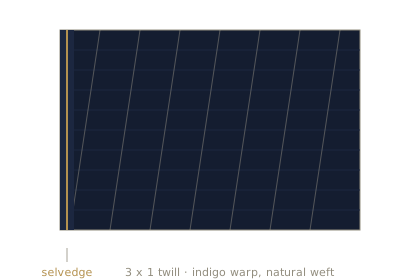
Fig. i — the self-finished edge. Woven on a shuttle loom, narrow and slow.
A second cloth, made in the Italian port of Genoa: jean fustian, a twilled cotton the sailors and dock labourers wore because nothing else survived the work. In French, Genoa is Gênes; the cloth became bleu de Gênes; and the English took the city's name and gave it to the trousers.
So the two words we now use for the same garment are two European cities. Denim is a French twill. Jean is an Italian port. Neither was ever American, whatever happened to them afterwards.
Two cities, two cloths, one garment. Before it was a symbol of anything, it was simply what working men could afford to ruin.
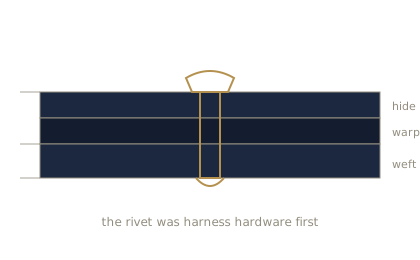
Fig. ii — a rivet in section. Hide above, cloth below.
Thread fails first. Any tailor knows it: the pocket corner goes, the fly goes, and the garment is finished long before the cloth is.
The answer was not a better stitch. It was a piece of metal — and the metal already existed, on the harness maker's bench, where rivets had been holding leather to leather for as long as anyone had ridden anything.
The rivet came out of the world of tack and saddlery. So did the heavy waxed thread. So did the leather patch on the back of the waistband, which is not decoration and never was: it is a hide label, cut from the same leather as a bridle, because that was the leather in the room.
Every jean carries a saddler's hardware and a saddler's hide. Most brands buy both in. We cut ours.
And we say so plainly.
There is a fashion for invented ancestry — for a date on a label that nobody checks and everybody suspects. We have no interest in it. What we have is a method that is genuinely old, and a workshop where it is genuinely practised.
We started with the leather, because leather is where the discipline is. Belts, the tool roll, small goods — vegetable-tanned hide, saddle-stitched by hand, two needles and one thread. A saddle has to survive a horse; work to that standard and everything else becomes easy.
The denim followed, exactly as it did the first time. Selvedge cloth, riveted at every point of strain, patched with hide we cut ourselves, on the same bench, by the same hands that make the belts.
Nothing here is antique. What is old is the method — and the method is the only thing worth inheriting.
Two needles, one thread, and a stitch that will not unzip when it is cut.
The craft